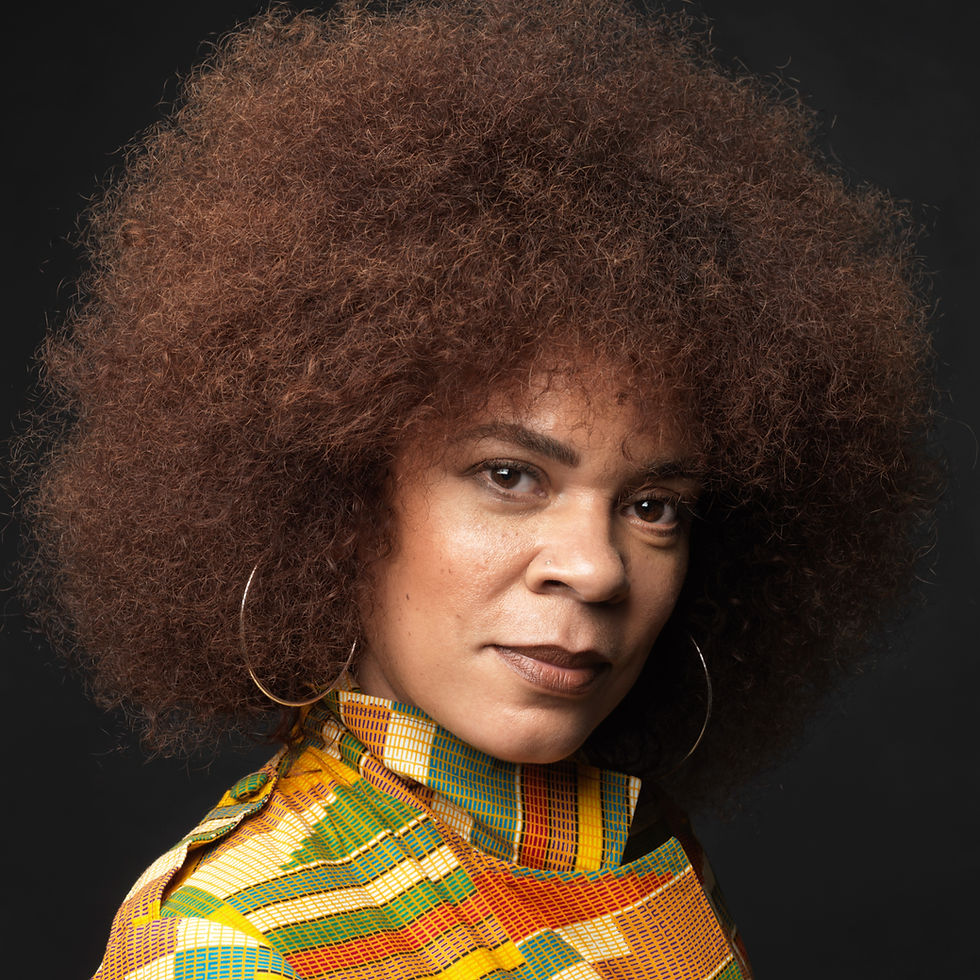
June 2026 Feature: Breena Clarke
Breena Clarke is the award-winning author for four novels, including her acclaimed debut novel River, Cross My Heart. She is a co-founder of The Hobart Festival of Women Writers.

Breena Clarke is the author of four novels, most recently published, Alive Nearby, a gently ruminative, epistolary work that explores characters in Angels Make Their Hope Here, Clarke’s 2014 novel set in an imagined mixed-race community in 19th-century New Jersey. Breena Clarke's debut novel, River, Cross My Heart, was an October 1999 Oprah Book Club selection and was named by Publishers Weekly as one of the seven essential books about Washington, D.C. Her critically reviewed second novel, Stand The Storm, was named one of 100 Best for 2008 by The Washington Post. Her short fiction has appeared in Washington Post Magazine, Kweli Journal, Stonecoast Review, Nervous Breakdown, Mom/Egg review, The Drabble, Catapult, Solstice, and Now, The Hobart Festival of Women Writers online magazine. She is co-founder of The Hobart Festival of Women Writers, an annual three-day celebration of the work of diverse women writers. She has been a member of the fiction faculty of Stonecoast MFA in Creative Writing at The University of Southern Maine. Breena Clarke is co-editor of NOW, an online journal of the Hobart Festival of Women Writers. She is on Facebook at https://www.facebook.com/breena.clarke, on Substack at https://breenaclarke.substack.com/. Find more at www.BreenaClarke.com.
Dog Triptych
Maisie’s Account:
A dog witnesses the most destructive racial conflict in American history.
Tulsa, Oklahoma 1921
May 31, the first night of the white people's rampage, a bottle of gasoline with a flaming rag crashed through our parlor window. We were in the kitchen and fortunate that all of us got out before the house was engulfed. We rushed out to the street, and nitroglycerin bombs were falling from the sky. We dodged about and hid beneath the dogwood tree nearby. Our home was on the second floor of Papa's undertaking business, The Samuel Bazemore Funeral Home. Like the other firebombed houses, our house was quickly consumed by flames because water lines to our neighborhood had gone dry. How? Why? We got nothing through our faucets, and our hoses were useless. Papa would not use the water in the rain barrel because he said that would only waste what little we had to drink. Oh, he was so clear-headed in a crisis! But his heart was broken at the devastation to his lovely funeral parlor and our home.
We were not alone. Businesses up and down Greenwood Avenue and Archer Streets were set upon, riddled with bullets, and burned. Then, after the first night's attacks, the sheriffs came and took all the colored folks to "safe" detention. Papa and Mama and Harold and Alice were taken off in a truck. I followed them to the armory and was barred at the gate. Papa and Mama and Harold and Alice were confined for two full days.
I saw the white mob. I saw what they did. The aromas of gunpowder, turpentine, nitroglycerin, sawdust, and human flesh permeated. A dense cloud of this malevolent amalgam sat above my head. Add to it the odor of their race hatred, and I could barely catch a clean, unencumbered breath. I sat on the periphery of the marauders and watched, listened as they descended upon Greenwood like a pack of wolves. As a dog, I understood them and understood they could not be stopped. Once a wolf pack has decided on a course of action, they do not arrest themselves for any reason of reason or compassion. I understood that I could not prevent them from carrying out their destruction. I could only witness. I'm very well-behaved and as clean as I can be expected to be. Mama has always regularly washed me with strong soap, and I have the lovely short, brindle coat typical of bitches who've been in Tulsa since the first people called it Tulsey Town. My line is long here about. I am here to watch and witness for Papa and Mama and Harold and Alice.
When they were let go, Papa, Mama, Harold, and Alice came back to the place our home was. The enthusiasm with which I greeted them nearly caused my chest to explode, and I almost knocked Mama to the ground. I apologized profusely by licking her hand, wagging my tail, and allowing Harold and Alice to pounce on me and hug my neck. They had been worried about me!
The Samuel Bazemore Funeral Home—our home—was nothing but ashes. Our furniture was gone or broken up and left in a pile. They couldn't haul off the bed that Mama and Papa slept in, so the looters hacked it to splinters. Papa took Mama into his arms and whispered to her that we children would lose all hope if she started bawling. She must be brave. Oh, that was all she needed to hear for Mama is very brave. She picked up a piece of the bedstead and used it to poke at piles of debris to see what we could salvage. The soot and ashes of our life covered Mama and Papa and Harold and Alice from head to toe. I could not see myself, but I, too, felt I was covered with what had once been our comfortable, happy home. Why had they burnt us out? We had never harmed anyone. Papa was an exemplary businessman. He was kind and considerate of folks in need. Mama was beautiful and dignified and kind, kind, so kind. Why would anyone want to harm them, their children, their home?
A Few Whiles
A dog waits at home for five years.
Chicago, Illinois 1960
Where is the elegy for the dog named Signal who waited at home in Chicago, in a backyard in a working-class neighborhood, for the return of a boy from a Mississippi vacation?
He went to spend some summer weeks with his cousins. We didn't want him to go – me and Mamie Mommy. But he was head-up and happy and excited to go on a trip for fun with his cousins. Summer vacation is our time. We long for it all through the long, tedious months at McCosh Elementary School. We earn our summer frolics because we are good, we behave, we do what Mamie Mommy tells us. We long to be hot and sticky with popsicle drippings. He promised we'll have summer when he's back. He put his arms about my neck and put his cheek to my ruff. He promised.
Waiting at the fence, on the porch. Waiting is most of that dog's life if truth be told. There is much running and romping and digging and all. But waiting for that boy is the largest part of it. Longing. Dog longing is different. It's maybe less sorrowful without the realization, the certainty, that the boy will not return. Poor exhausted fool animal to wait and grieve and wait beside the back gate for five years after the summer that boy didn't come back. A couple of times she considered putting the animal down to ease the misery of its waiting. Surely, it is more kind to ease it away from that fence, those sticks and balls and caps and jackets and sneakers and cat's-eye marbles, and those beloved sneakers of his. Couldn't do that. Whispered in its ears; hugged its thick neck. To touch that animal's head, to smell him, to be tugged down the street with him, was to have a fleeting feel of that boy. Let him wait if that's what he wants. She left him to it.
My tender, sweetheart boy child. He was a tender aged child still. He wasn't a man.
"It would appear that the state of Mississippi has decided to maintain white supremacy by murdering children." —Roy Wilkins, head of the NAACP
Sleep is fraught for a faithful dog waiting for his boy. Short naps, circulating the yard, waiting at the gate, coming to greet Mamie Mommy home from work, home from church. Where is my boy? Summer goes, Autumn comes. Winter. Spring. Summer. Autumn. Winter. Spring. Summer again and again.
Signal:
Why doesn't he come home?
Bobsey:
The crackers who tied his body to a seventy-five-pound cotton gin fan know. They know that boy won't be home and they know why.
Moses Wright's dog, Bobsey, knew what he didn't know. Bobsey figured it. Mr. Moses was scared for himself. His ass was on fire with scared. Who could blame him? Maybe he figured the milk of human kindness would keep them from killing a child. Bobsey knew better. Bobsey smelled him that last time. And Boy's life and limb and luster was the very last thing Bobsey smelled. Bobsey understood it all. For when Bobsey ran at the man's leg to save the boy, to slow the vicious acts, a kick came, and then a bullet. Bobsey's life oozed onto the ground. Bobsey'd set her essentials into this man's leg, the fat part of his calf, and he had to shoot her to take her off. * Mr. Moses and 'em cried, "Bobsey, come off!" They tried to call Bobsey off like they'd call her off a possum. Bobsey ignored 'em.
The Testimony of Bobsey: Let me explain it this way. I smelt it all. I smelt the entire outcome. Mr. Moses and 'em can only imagine, but I smelt it. They're free to hope for the best. But I smelled each and every murderous intention in the base souls of the crackers that came for Boy that night. Every muscle in me acted with the instinct to protect Boy from this horror. I put myself between Boy and 'em killers because I knew the odor of their purpose. I did what I was able before I died. I was in heaven forthwith. And I witnessed the ascension of Boy's magnificent, unblemished soul a short time later. Frisky, callow, and still a child.
*Subsequent accounts of the events of August 24, 1955, do not include the fact that Roy Bryant sustained a dog bite on that night.
Mike, Friend of The Famous
A dog befriends a great Civil Rights leader.
Washington, D.C. 1974
They say our line has been spoilt by empathy. We are not as aggressive, vicious, driven to subdue on command, or as dogged as others of our breed. We began as offspring of the Great Black and Tan Coonhound, who is said to have been sired by Hellhound, a dog belonging on the plantation at Swanigan's Neck, North Carolina, and a bitch named Black, brought to the Americas on board a slaver from the African coast as a pup. The Great Black and Tan was, for many years, the companion of Caleb Bledsoe, a slave trader and driver whose plantation burned to the ground in 1853. In Black's line of dogs, the bitches are gentle though brave and staunch. And this admixture of compassion is the very attribute that distinguishes our line. Really, our line is wanted for our looks. We are beautiful and imposing. In my youth, I stood tall, had a broad, deep chest, a graceful and powerful line of body, and a lovely black coat with tan saddles. I still have a massive head with erect ears, a long snout, and a mouth full of the most perfect essentials as would ever clamp upon a limb of bone, meat, and gristle. I could do real damage to fleeing flesh. But my heart is hardly ever in the mood. In my working days, I followed commands without question, but I labored to be keen. Keenness for a task, a pursuit is not a learned thing but an inheritance. Most often, my imposing appearance was seen as ferocity, and miscreants froze in fear of me. I was required simply to hold their attention, help the police officer to take them into custody. My complete undoing came when we were urged to step up our ferocity, when we were called to control groups of marching Negro protestors.
King Chester, the so-called alpha dog at the Birmingham canine corps, likewise descended from Hellhound, berated me for gentleness. He was always eager for blood on his muzzle and the opportunity to invest his essentials in the flank or backside of a troublemaker. He was vicious and had risen to prominence because he was ruthless.
King Chester distinguished himself. He is famously depicted lunging and biting Walter Gadson, a student at Parker High School in Birmingham, Alabama. And he is captured ripping the clothes off Harry Shambry, another Birmingham man who was protesting the unfair treatment of black people in 1963. Photographs of King Chester with his essentials fully deployed appeared in newspapers and magazines worldwide. The New York Times, The New York Daily News, as well as, in The Clarion, Time Magazine, Life Magazine. The nation was horrified at the Birmingham police. But King Chester was a celebrity in some circles. I am seen in this photo, too, though not lunging and biting. I am sitting, watching. I can only say that I must have been pondering our actions, questioning our orders. And then the photograph of me being bussed and petted in the back of a police car by The Reverend Dr. Martin Luther King, Jr. surfaced.
I assure you there were no kind words for me. My name became disparaged instantly. "Don't be a Mike," they warned the other dogs. Some solace came several months later when The Reverend Dr. Martin Luther King, Jr. answered his critics and clarified his intentions and his beliefs in "Letter From A Birmingham Jail," which was printed into pamphlets and distributed throughout Birmingham, the rest of the south, and in cities nationwide. My jailers grabbed a pile of mimeographed copies of the letter that they'd ripped from the hands of protestors, and they lined my cage with them. I was compelled to pee and shit upon these papers, upon the words of my friend, The Reverend Dr. Martin Luther King, Jr. But I read his words first, and I was buoyed by them.
" . . . I am in Birmingham because injustice is here."
I was stripped of my rank and pension after this picture became widely distributed. It was seen by some as a testament to The Reverend Dr.'s goodness, his likeness to Christ, and that my evil was thwarted by him. I was turned out by the sheriff's department to fend for myself. "Go down to niggertown," they said as I slunk away from the Birmingham canine jail. I foraged to get along. I was thrilled when the Reverend Dr. was named Time Magazine's Man of the Year.
I moaned with abject grief when I learned of the bombing at The Sixteenth Street Baptist Church on September 15, 1963. I began to question the humanity of the people I had heretofore worked on behalf of. That the perpetrators were known to the police, that they felt they could act with impunity, that they snuffed out the lives of four girls, Addie Mae, Carol Denise, Cynthia, and Carole, that the aroma of the girls’ singed hair still wafted about when I approached the scene, was to me an abomination. Though noticeably thinner, I was still formidable. Onlookers parted and I was allowed to come close to the devastated church. I proceeded on my belly, moving along the ground, but I soon retreated. I do not want to reflect upon all that I smelled, all that was lost.
By 1965 I had made my way to Selma, Alabama. I was on the Edmund Pettus Bridge far at the back of the marchers, behind the Great Reverend Dr. Martin Luther King, Jr., and his wife as the protestors began to march toward Montgomery. I was so sickened at the sight of King Alpha and the others with their teeth bared, with hellfire in their eyes, poised, willing, and able to tear the Reverend Dr. and all the other marchers for Freedom to shreds, that I peed and shat uncontrollably at the entrance to the bridge. I was unable to regain control of myself. I ran off in panic as the marchers were set upon viciously by the police and the dogs.
How many of us have said that we knew our dear friend The Reverend Dr. would not live a long life? Yet I feel I can say that I did know even as far back as the day I first smelled him in the back of the police car. I have had a presentiment of his horrible death and I have mourned him well before he was shot. My heart felt like lead after April 4, 1968.
Curious about the identity of the dog photographed with Dr. King in the back of the police car, Nicolas Von Hoffman, the heroic journalist for The Washington Post who was covering the Civil Rights Movement, sought me out and rescued me from grief and privation. He brought me to Washington, D.C. He wrote a delightful human and dog interest article about me and Dr. King. He wrote of how shabbily I was treated by the Birmingham Police Department and that I was, in fact, without a home. He gave me into the care of a Howard University student named Ifeoma, who works at The Post as a Dictaphone typist. Ifeoma had spoken up to say that her home would always be open to such a heroic dog. Ifeoma had been known as Edna Luise Clarke previously to the African awareness movements of the sixties and seventies. She changed her hairdo—she now wears a pretty Afro bush like Angela Davis—and her name in 1971 and is now known as Ifeoma L. Clarke. I have resided with my beloved Ifeoma for four years. I am occasionally intimate with a brindle bitch named Tammy and am known in activists' circles as Mike, the dog who befriended The Reverend Dr. Martin Luther King, Jr.
THE INTERVIEW
This interview was conducted between Breena Clarke and Jae Nichelle on March 29, 2026.
“Dog Triptych” offers us an atypical perspective on key civil rights events. Can you speak to what led you to tell these stories through canine voices?
Well, I am, first and foremost, a lover of dogs. The idea began as a joke. My husband and I joked that Sacajawea may have had a dog named Fluffy on her trip west with Lewis and Clark. From there, I imagined other historical events that may have had canine witnesses. I began to explore the fact that canines have accompanied most of the meaningful encounters in American History. And perhaps most importantly, canines have been active participants in historical events such as the enslavement of kidnapped African people and the subjugation of indigenous people. The most notable aspect of the special relationship between humans and canines is the eyes. They can return our gaze, look back at us with what seems to be understanding. We have had great success with training them to do our bidding. We’ve used them in many capacities. They’ve been hunters, trackers, assassins, guards, intimidators, and loving domestic companions. We are so self-referential and so eager to bridge the gap of understanding with these special creatures that we imagine they understand and respond to us. And if they have understanding – or seem to – then I can explore the idea that they also have a deeply meaningful perspective on what they’ve been made a part of. We look at them, and they look back. We see ourselves as another creature sees us. It’s powerful. We don’t have this relationship with any other animal. It’s about us humans wanting the communication and them wanting to please us. Also, many people find dogs fascinating. They are an easy hook for a story. We associate them with comfort and fun and with noble concepts of loyalty, bravery, childhood innocence, and the pleasures of tactile experience. The use of a dog as narrator is my idea of a good way to make my readers thirsty for the tale.
In the first section, the dog Masie says, “I understood that I could not prevent them from carrying out their destruction. I could only witness.” Some people say that witnessing is the role of the writer. What is your relationship to ‘witnessing’ in your work? Does it feel like a foundational part of your job?
Indeed, I do feel the role of witness is fundamental to the writer’s job. I think that, essentially, writing is a job. I chose to designate our profession as a “job” so that we don’t get distracted by higher, more lofty ideas about art. We writers are journeymen(journeypersons). Specifically, we look at and experience the world and make a record. We document. I suppose it began as a way not to forget an individual who’d died. This sets up the infrastructure of witness. This is fundamental to my work because I feel it’s necessary to put down an account that is different from the mainstream historical record, very specifically an African American perspective. I chose fictional accounts of historical facts because I enjoy imagining the lives of people who are underrecognized. I can give these people/characters everything that historical America wants to deny them. There’s a wealth of material in there. This feels very important to me, like my niche. Developing these stories feels like something I must do. Fiction is an important device for historical perspective since it lures the reader into the story by hooking their attention with a beguiling tale. I like to say: You can lead a horse to water, but you can’t make them drink. The fiction writer’s job is to make the reader thirsty. Then you don’t have to make them drink.
Your newest book, Alive Nearby, further develops characters from your previous books. What was it like to dive back into these characters long after you first dreamed them up? Or had they never left you?
I like that “dreamed up” phrase. That is how I feel it happens – dreams. It was fulfilling to return to those characters, and you are right to suggest that they are still with me. Alive Nearby allowed me to look at the residents of Russell’s Knob a bit differently and to expand their lives. I chose to use the epistolary novel format so that I could allow my protagonist to communicate across the life/death divide. There is also an element of this in my dog stories. I am trying to create a conduit for communication across an interspecies platform. Though I have not conducted much genealogical research of my own, I am fascinated by family interconnectedness. Exploring the lineages of the people of Russell’s Knob allows me to speak to the white supremacist idea that African Americans have little or no knowledge of their family. The cruel policies, covenants, traditions, and practices that kept African Americans from realizing potential and even remaining together in family communities are stunning in their persistence into the 21st century.
What is surprising you most about your writing these days?
That I am still doing it. I’ve recently celebrated my seventy-fifth birthday. The great thing for writers is that advancing age need not affect your ability to continue writing. And, I am happy to note, my maturing brain has layers of insight that were not available to me when I was younger. Now I’m more comfortable with what I can accomplish. I no longer feel the need to measure myself against other people. Longevity is a double-edged sword. I feel privileged to have survived and thrived for so long, but I mourn the passing of others. So, I suppose that recreating them in my mind and my fiction gives them flesh again and gives me comfort. I also feel an imperative to record twists and turns of language and customs that might pass away if not embedded in a novel or story.
My sister, Cheryl Clarke, my play-sister, Esther Cohen, and I are contributing to and editing an upcoming anthology of writing by Crones, i.e. women writers over the age of sixty-five. This anthology will contain great work by some wonderful writers. Our work will include witnessing, as well as imagining.
You have a very beautiful blog. In it, you mention that you learned to swim at age 49, and it became very important to you. What do you enjoy most about being in water?
My first novel, River, Cross My Heart, is my mother’s coming-of-age story. She was a girl who learned to swim as a child when many young African Americans did not. Segregation kept most Black people out of municipal pools. My mother was taught by Charles R. Drew, who was the first African American administrator of a public pool in Washington, D.C. He was, as you know, an outstanding physician who went on to do pioneering work in the development of blood plasma. When I was a young girl, we were discouraged (by my mother) from pursuing swimming because we pressed our hair. Straight hair was mandatory for African American girls in that era. I came of age when Angela Davis famously wore an Afro, so I went natural when I got to Howard University. After writing River, Cross My Heart, I was asked to do a series of talks on the importance of learning to swim for city high schoolers. As compensation, I was given one-on-one swimming lessons at Asphalt Green in New York City. It was a transformative experience. I learned different things about my body: that I am strong, that I can see without my glasses, that floating is easy and sublime, that body size and definition are immaterial in the water, and that my body can accomplish things my mind thinks are not possible. I also learned that much of what I’d written about the experience of swimming was accurate. Since learning to swim, I’ve ruminated about my writing in my neighborhood, municipal pool, and I’ve become part of a community of women who attend a twice-weekly aqua aerobics class.
In a 2016 interview, you said that one thing that helps you as a historical fiction writer is “the realization that even verifiable facts are open to interpretation, that many historical accounts are fiction-fied.” When did this realization first hit you?
As I undertook research for my novel, Stand The Storm, which is set in Civil War-era Washington, D.C., I quickly saw there was a paucity of accounts by African Americans, and even fewer from African American women. As I read, I began to realize that historical accounts were, by and large, a matter of perspective. If you’re the man atop the horse viewing the rest of humanity from a lofty position, then you will see what is available from your perspective. If you are trudging down a row with your head focused on the ground in front of you, you will see things differently. Generally, the person at the top of the hierarchy gets to call the shots. “The higher the monkey climbs, though, the more he shows his behind.” When the downtrodden get a view and a voice, they very often expose a lot that has been hidden heretofore.
What is one of the most memorable moments you’ve experienced at the Hobart Festival of Women Writers, a festival you’ve co-run since 2013?
We’ve had many outstanding and important writers at the Festival since 2013. And I’m proud to say, we’re the only women’s writers’ festival east of the Mississippi. The most memorable Festival would have to be our first year. We’d conceived the idea of inviting women we knew and/or had become aware of who’d published work and who, we felt, were underrecognized. We invited them, but weren’t sure they’d really make it. They did, and they were fabulous. The most exciting aspect was the camaraderie. Several collaborations have emerged, as well as lifelong friendships.
How can people support you right now?
They can support the Hobart Festival of Women Writers at our GoFundMe campaign.
The administration of HFWW is an all-volunteer operation. However, we’ve always offered a modest honorarium to all participating writers at the Festival. This means a lot to us because women writers don’t always get the support they deserve.
I’d be thrilled to welcome new subscribers to my Substack blog at https://breenaclarke.substack.com/
Check out my books at http://www.breenaclarke.com/
Name another Black woman writer people should know.
It is difficult to choose one. I will suggest two names: Alexis DeVeaux, novelist, poet, playwright, essayist, and thinker. Hers is truly innovative work. Check out her most recent novel, “Yabo.” Also, I name Cheryl Clarke, poet, essayist, teacher, and activist writer. Cheryl is my sister, and I have been nurtured and educated by her since always. She has been the most important influence on my life and writing. And she’s a hellified and well-recognized poet.
###
Torch Literary Arts is a 501(c)3 nonprofit established to publish and promote creative writing by Black women. We publish contemporary writing by experienced and emerging writers alike. Programs include the Wildfire Reading Series, writing workshops, and retreats. Click here to support Torch Literary Arts.