March 2026 Feature: Bettina Judd
Updated: Mar 3
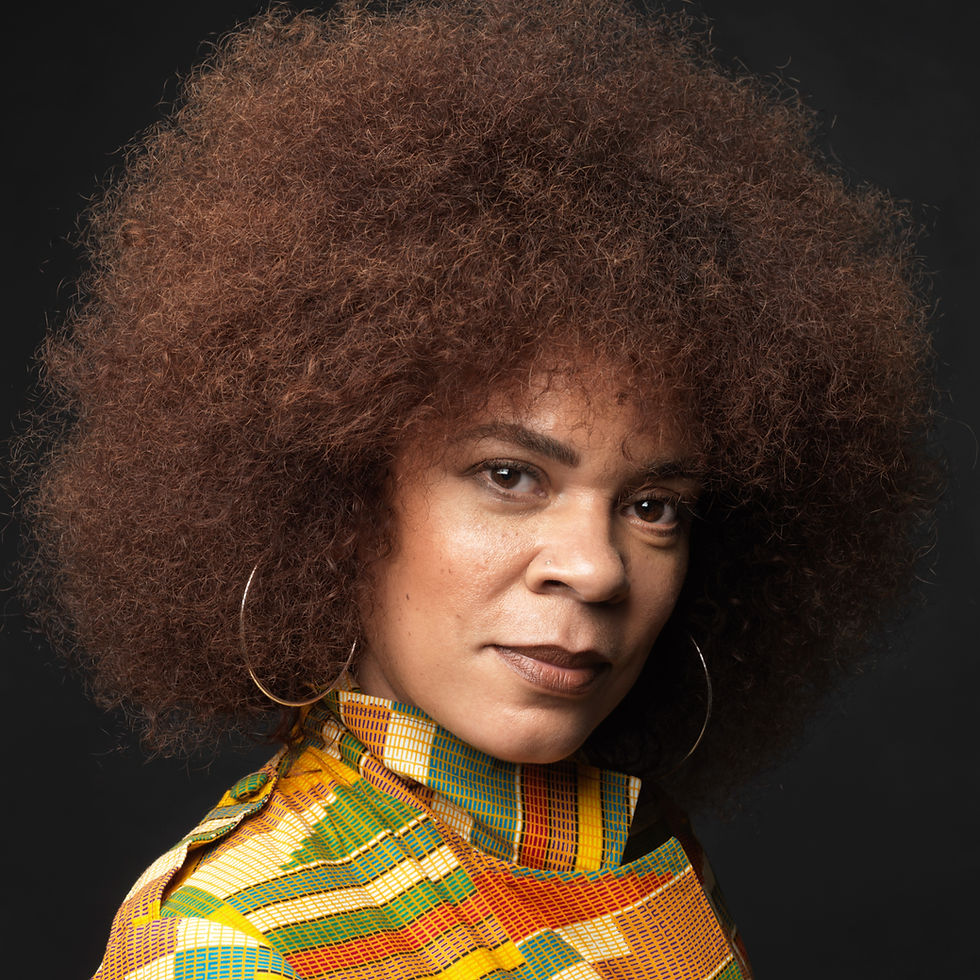
Bettina Judd is the award-winning author of Feelin: Creative Practice, Pleasure, and Black Feminist Thought and patient.

Bettina Judd is an interdisciplinary writer, artist and performer whose research focus is on Black women's creative production and use of visual art, literature, and music to develop feminist thought. Her book Feelin: Creative Practice, Pleasure, and Black Feminist Thought (Northwestern University Press, December 2022) argues that Black women’s creative production is feminist knowledge production produced by registers of affect she calls “feelin.” She is currently Associate Professor of African American Studies at Emory University. Her poems and essays have appeared in Feminist Studies, Torch, Mythium, Meridians and other journals and anthologies. Her collection of poems titled patient. which tackles the history of medical experimentation on and display of Black women won the Black Lawrence Press Hudson Book Prize and was released in November of 2014. As a performer she has been invited to perform for audiences within the United States and internationally.
Black Notes in Grief (an excerpt from Feelin)
It is the sound that opens wide everything else.
We touch on death in Black studies because we must. Because the condition of Black life is so often described by our proximities to death.¹ (As in, “The only thing I have to do is stay Black and die.”) In the study of Black death, one must touch (mustn’t they?) the feeling of being in death’s wake. I wonder, in the notes to this chapter, how Black grief is in the structure of Black studies—if not this Black study. The pursuit of this question, How is grief structured within Black studies? requires a distance from the matter of grief that I would rather relegate to the notes. This book is about feelin after all—about leaning into the affective sedulity of Black creativity and to pursue this question without attending to the experience of grief seems like an ironically performative byproduct of the “race for theory.”² It’s much easier to talk about than do or be in grief. In the context of this project, it would be disingenuous of me to pursue this question without feelin because the real question about grief in Black studies, about Black people and grief, is . . . . . . . . . ? Because the real question is uttered in a language difficult to transcribe on the page. It is ineffable, this thing called grief, and expository propositional prose sanitizes its contents.
The content of this chapter is grief—as well as I could communicate it as I wade through my own experience of grief in the process of writing this book. I wade through grief with Black studies to do this work and also to make sense of Black terror, loss, sadness, and all of the other unnamed affective experiences that grief attends to. Even that attempt to structure grief is too clinical. In my grief, Black studies, particularly Black feminist studies has been my companion—a wrenchingly honest friend. Sometimes too honest, but always there. Such brutal honesty is what I hope to learn from word work—from Black feminist writing that I reference, and from my community of friends that take Black feminism to praxis. These notes are a contemplative commons, an acknowledgment of the “wake work,” to invoke Christina Sharpe, that precedes my own.³ The notes stop where the meditation on grief, here titled, Salish Sea begins in text, but the citations within these notes inform the poems on a cellular level. I thank Alexis Pauline Gumbs and Saidiya Hartman for crafting examples of this kind of poetic citational practice.⁴
As these notes close, I imagine myself in a room full of these cited thinkers that I feel. (Imagine, if you will, yourself in the room as voyeur, or if you feelin me, participant.) We are talking and sharing our experiences, we present evidence, pour over archival artifacts, and wonder at what we find. We pontificate, reference, and speechify. We might even laugh. There is a point at which they all must go home, away from the din of our party and as I close the door behind them, their words, thoughts, and feelings have not left me. But, in the silence of the room in which I physically (work with me) remain, I meet myself and all of what could not be said before and after our meeting full of life-breath and sorrow comes up through my belly into my chest, my throat, and eyes. It fills me and overflows—becomes the room. This is what could be recorded. It seemed to be embedded in the language of Black life.
The blues is a Black condition. The roots of the musical genre are explicitly drawn from the processes of cultural, spiritual, and bodily displacement and subjection. It would seem that a study of the aesthetics that shape the blues and its descendant musical styles would also be a study of grief, if not grievances (a point I discuss further below). Grief and grievances are cellular to the aesthetics of Black music. As Amiri Baraka notes of the antecedent of the blues, field hollers “were strident laments, more than anything.”⁵ So cellular were these wordless affective musical riffs to Black music that for Baraka, they could be considered lyrics—lyrics that communicate the ineffable and the identifiable (i.e., This is my grief.) Follow me here. I know that the ability to think through the aesthetics of a genre does not a study of grief make. There are way too many tributaries, and often, they are less difficult to sit with than grief. But the blues would certainly be core to an aesthetic interrogation of a study of Black grief. The riff marks the communicative possibilities of expressing the ineffable contours of grief’s feeling. There is a story about Funkadelic’s “Maggot Brain” that comes to mind here: for the record, George Clinton told Eddie Hazel to make grief out of his guitar. In his words:
I told him to play like his mother had died, to picture that day, what he would feel, how he would make sense of his life, how he would take a measure of everything that was inside of him and let it out through his guitar . . . when he started playing, I knew immediately that he understood what I meant. I could see the guitar notes stretching out like a silver web. When we played the solo back, I knew that it was good beyond good, not only a virtuoso display of musicianship but also an unprecedented moment of emotion in pop music.⁶
The aesthetics of the riff—the circular ascending and descending repetition, the distorted and imperfect tonality of Hazel’s guitar, the vocal-like melismatic divergences express grief as it is felt, sonically. Hazel’s song-length solo was so mesmerizing that Clinton had the rest of the band dropped from the final recording save for a simple melancholic melody on second guitar that points to where Hazel occasionally lands. As the quote suggests, Clinton understands this song to be a signal of the band’s maturity as musicians—that their ability to express emotion matched their technical proficiency. Emotional dexterity within musical proficiency is fundamental to the aesthetics of funk and blues—to be proficient in spanning affective registers through musicianship and grief made that clear.
The lesson of the riff is instructive here. As studies of Black folks consider the social conditions of Black people, so they must consider the structures of feeling by which Blackness in Black studies must operate. The “social experience in process” to borrow from Raymond Williams, is ongoing as we feel, think, study, live, write, and teach Black studies.⁷ The aesthetics of the riff tells us that there is no singular note that encompasses a singular feeling (i.e., grief or pleasure or anger) and no singular series of notes either. Not a solid line pointing us in one particular direction, but “notes stretching out like a silver web.” A study of pleasure would so encounter, nay, become a study of grief—such is the web of Black studies’s dexterous structure of feeling.
“Loss?”
Recovery uncovers what stays lost. Mamie Till Mobley remembers the painstaking and dreadful process of recovering the body of her son: “I looked deeply at that entire body for something, anything that would help me find my son. Finally, I found him. And lost him.”⁸ Her son, difficult to recognize because of the brutality of racist violence that ripped him away from life and her mothering arms, is only recoverable through memory. Emmett’s body both a recovery (through memory of his life) and a final rupture (violent death).
What is lost stays lost but the open chasm of something was here remains as memory. Saidiya Hartman notes, “the slave was the only one expected to discount her past.”⁹ This loss was the ongoing process of forgetting homeland, mother. Hartman goes on to describe the folklore of coercive forgetting: Everyone told me a different story about how the slaves began to forget their past. Words like “zombie,” “sorcerer,” “witch,” “succubus,” and “vampire” were whispered to explain it. In these stories, which circulated throughout West Africa, the particulars varied, but all of them ended the same—the slave loses mother.¹⁰
Perhaps this is the fundamental difference between discussing grief and discussing loss—loss does not require memory whereas grief does remember what has gone. Memory can be lost, too. Hartman’s return to the site of lost memory intones grief through her encounter with memory, mind, and mother, by returning to the place of forgetting. This site-specific experience of remembering what was meant to be forgotten is what Toni Morrison calls rememory.¹¹ Rememory is the glitch in space/time between what is meant to be forgotten in a past and what is reencountered as memory in the present. Here she presents the concept in the voice of Sethe:
I was talking about time. It’s so hard for me to believe in it. Some things go. Pass on. Some things just stay. I used to think it was my rememory. You know. Some things you forget. Other things you never do. But it’s not. Places, places are still there. If a house burns down, it’s gone, but the place—the picture of it stays, and not just in my rememory, but out there, in the world. What I remember is a picture floating out there outside my head. I mean, even if I don’t think it, even if I die, the picture of what I did, or knew, or saw is still out there. Right in the place where it happened.¹²
Whom or what reminds you, refuses release of the tether and makes past time as lucid as the present and carries some message about the future. Or as M. Jacqui Alexander says, “Spirit brings knowledge from past, present, and future to a particular moment called a now.”¹³ In this bending of space/time, rememory enacts sacred touch—witness from the dead, the unborn, and not to be forgotten. Hartman finds recovery to be illusive as the rupture between Africans and descendants of African slaves expands beyond the width and depth of the Atlantic Ocean. Whatever is thought to have been forgotten has been etched in rememory as hauntings, familiars, and familiar sites of terror that live with those who remember. Rememory means nothing is forgotten though it may be lost, and that memory, along with that loss, makes way for grieving what has gone.
I sat down to work on this very book and could only wail in poems.
I call this a whale/wail of poems. Much like a crown of sonnets, but named for the grieving orca whale J35 aka Tahlequah, who carried her stillborn calf for seventeen days after its birth. Like a crown of sonnets, the final line of each preceding fourteen-line poem starts the first line of the next poem and the final poem ends with the first line of the very first poem in the sequence. There is no master poem in this sequence, but it does consider what comes after.
To be living a footnote to a text about Black life which is inevitably about death.
Yet, here we are the in the notes trying to make sense of this wail of poems—trying to build some context for why grief is important for this study. What I am saying is that Black studies is enshrouded by grief. I am feelin Black studies in my grief. Grief is Black studies’ affective sedulity. It is Black studies’ errant and unproductive feeling that challenges Western civilization’s organizing systems of knowledge. Even as Black studies asserts productivity—toward freedom, against academy, challenging knowledge itself—grief bookends such claims with “circles and circles of sorrow”—the repeating riff, the everything and nothingness to which Western civilization finds no order, use, or value, particularly in the living ghosts of not quite humans.³³
The number doesn’t matter, shouldn’t matter.
This chapter is not about the dead but about the conditions of life for those left behind to live and remember. I may count the ones I mourn. They were my 11, my 12, my 13, but to count them just increases the number and forces me to ask myself, who do I choose to mourn? I recount their names in this wail. Their accumulation, their numbering is an effort to communicate a feeling of loss that cannot be neatly processed. As Woubshet notes of compounding loss in the early era of AIDS, “the pain, the confounded psyche, the exhausted body and soul—of each loss are compounded by the memory and experience of the losses just before.”³⁴ The steps of grief, the periods of mourning, the promise of linear time’s healing properties fail when accumulation becomes stasis. To count may give credence to the “mathematics of unliving” that, as Katherine McKittrick notes, produces Blackness through a sum of violence and violations.³⁵ What is missing, unrecognized—unrecognizable—in the archive and its tabulations is the evidence of grief. Grieving responds with the enumeration of the dead with its same song wail. Chaotic and uncontained. This Black study in grief is interested in that which is and must be unaccounted for.
This Black grief is an accumulation of feeling
How do you grieve that which is ongoing? Or as Hartman queries, “How might we understand mourning, when the event has yet to end? When the injuries not only perdure, but are inflicted anew? Can one mourn what has yet ceased happening?”³⁸ Injuries, inflicted anew. For instance, the fear of police violence in the course of grieving. In the summer of 2016 when doctors told my mother, uncle, and me that my grandmother was absolutely dying and there was no other course of action to take to stop the process, I went into hysterics, crying and begging my grandmother to stay with us at her bed. Nurses called security as my uncle shook me into a calmer state, telling me that security would drag me out of the hospital. Sexist and racist medicine has so sanitized the course and culture of death and dying to make such an outburst of grief from a Black woman intolerable if illegible. By making death the domain of the (white) and male-dominated medical field, the family is estranged from the process of dying. My outburst is dangerous chaos, not a rational course of the grieving process that accompanies the death of someone who is loved. As Sharon Holland notes, “The family is constructed as unstable, relative to the ‘neutral’ and universalizing gaze of attending physicians.”³⁹ The hospital, unequipped for the unruly knowledge of death and dying by the family, is however equipped, through its carceral allegiances, for the emotional outbursts of Black people via security systems and police force, violence, and confinement. Like Black deaths caused by state violence, there can be no Black witness—or rather—Black witness is disregarded as untrustworthy. If as Holland writes, “death, as an unspeakable subject in a hospital ward, is divested of its own language and is consumed by the scientific knowledge in the physicians’ possession,” Black grief is the language by which Black death is acknowledged—even its tone and pitch is wildly outside the aspects of bedside care that can be served in the medical field or Western knowledge.⁴⁰ To think that my own life or the life of my family members might have been in danger because of my expressions of grief is personally overwhelming, but also signifies on griefs accumulated and confluent. My Black grief grieved by the confines of ungrievability. There is no common sense for Black grief that holds space for grieving even as Black death is so common-sense, to be expected, and to be in fact so “juridically sound” as Sharpe notes, that the nation’s functioning depends on the reproduction of Black death.
Black expressions of grief may take iconic status in the process of attempts at juridical redress as the widely produced photos of Mamie Till Mobley weeping over her son’s coffin and the photo of Tracy Martin, Trayvon Martin’s father’s open-mouthed wail demonstrate. These images produce the narratives of grief as grievance necessary for certain kinds of movement building and are so legible as productive strategy. Grief itself, however, becomes lost in grievance’s show. As the aftermaths of the attempts at juridical redress for Emmett Till and Trayvon Martin (and on . . .) demonstrate, no such reparation could be found. What else could we expect our grief to do if Black death is, as Sharpe notes, “a predictable and constitutive aspect of this democracy?”⁴¹ What is our grief—loud and disruptive—if not for us?
Remember? They gone.
Holloway ends Passed On with such an illustration of the ways of grief to arrest—to flow forcefully through cracks unexpected or unexamined. On her way to view the site of Richard Wright’s remains with her daughter Ayana, she begins to recount her childhood practice of collecting chestnuts to make necklaces, and then:
We were relaxed and at ease until we got to the site where those who had been cremated were interred. There I stopped silent, stilled but for the tears that clouded my sight. I thought of my child, our son, her brother, and I could go no further. And so, we left together, her hand in mine, turned toward home.⁴²
Grief is the perfume of our stifled air. Even in the most joyous of our days we may be caught by its waft—blown in by the weather and our weathering.⁴³ My knees might buckle from its sudden strength and bring me to the earth beneath, senses shaken by gravity’s pull. All that is left is this sound.
Further Notes
Yemaya and the Maiden of Deception Pass (Kw?kwál?lw?t)
Yemaya appears here as mother of the children of water and of water itself. Known also as Yemoja, Yemanj., Iemanj., and Jana.na (all matters of geographic and cultural location), this orisha is revered as an embodiment of motherhood, nurturance, as well as communications and trade cross the waters. As Solimar Otero and Toyin Falola note in the introduction of Yemoja: Gender, Sexuality, and Creativity in the Latina/o and Afro-Atlantic Diasporas this orisha is “also associated with other water deities, such as Ol.k.n in Nigeria and Mami Wata across West and Central Africa.”⁴⁴ For her followers in the Americas, she often has special meaning as a nurturing mother who protects her scattered children across the waters—connecting them to Africa’s Western shores. As poet Olive Senior writes: “From Caribbean shore / to far-off Angola, she’ll / spread out her blue cloth / let us cross over—.”⁴⁵ She appears in relation to the Samish spirit/deity Kw?kw.l?lw?t (pronounced Ko-kwal-alwoot) also known as the Maiden of Deception Pass who wades around in the waters of the Salish Sea and sometimes in the wake of canoes.⁴⁶ Once human, she sacrificed herself to dwell forever in the waters with the king of the sea so that her people could eat.⁴⁷ She acts as a sea-dwelling guardian who provides her people with sustenance from the waters of the Salish Sea and the surrounding fresh waters. She continues to be a guardian of her people.
[Notes to the Notes]
1 Claudia Rankine titles an essay on racial violence with a quote from a friend, “The condition of Black life is one of mourning.” Claudia Rankine, “The Condition of Black Life Is One of Mourning,” New York Times, June 22, 2015, sec. Magazine, https://www.nytimes.com/2015/06/22/magazine/the-condition-of-black-life-is-one-of-mourning.html.
2 Barbara Christian, “The Race for Theory,” Cultural Critique, no. 6 (1987): 52. https://doi.org/10.2307/1354255.
3 Sharpe describes “wake work” as new ways of “plotting, mapping, and collecting the archives of the everyday of Black immanent and imminent death” as well as “tracking the ways we resist, rupture, and disrupt that immanence and imminence aesthetically and materially.” In that spirit, this chapter does not “seek to explain or resolve” the structure of grief for a Black collective, but simply grieves and tarries with other studies of grief and grieving. Christina Sharpe, In the Wake: On Blackness and Being (Durham, NC: Duke University Press, 2016), 13, 14.
4 Saidiya V. Hartman, Wayward Lives, Beautiful Experiments: Intimate Histories of Social Upheaval (New York: W. W. Norton, 2019); Alexis Pauline Gumbs, M Archive: After the End of the World (Durham, NC: Duke University Press, 2018).
5 Leroi Jones [Amiri Baraka], Blues People: Negro Music in White America (New York: Harper Perennial, 1999), 28, 60.
6 George Clinton and Ben Greenman, Brothas Be, Yo Like George, Ain’t That Funkin’ Kinda Hard on You?: A Memoir (New York: Simon and Schuster, 2017), 103; italics mine.
7 Raymond Williams, “Structures of Feeling,” in Marxism and Literature (Oxford: Oxford University Press, 1977), 132.
8 Mamie Till-Mobley and Christopher Benson, Death of Innocence: The Story of the Hate Crime That Changed America (New York: Random House, 2011), 247.
9 Saidiya Hartman, Lose Your Mother: A Journey Along the Atlantic Slave Route (New York: Macmillan, 2008), 155.
10 Hartman, 155.
11 See also Rae Paris’s poetic collection that takes up the site-specific aspect of rememory. Rae Paris, The Forgetting Tree: A Rememory (Detroit: Wayne State University Press, 2017).
12 Toni Morrison, Beloved (New York: Knopf, 2007), 43.
33 From Nell’s moments while thinking of her friend, Sula. Toni Morrison, Sula (New York: Knopf, 2007), 155.
34 Woubshet, The Calendar of Loss, 3.
35 Katherine McKittrick, “Mathematics Black Life,” Black Scholar 44, no. 2 (2014): 17.
38 Saidiya V. Hartman, “The Time of Slavery,” South Atlantic Quarterly 101, no. 4 (2002): 758.
39 Holland, Raising the Dead, 34.
40 Holland, 35.
41 Sharpe, In the Wake, 7.
42 Holloway, Passed On, 212.
43 Christina Sharpe describes weather as “antiblackness as total climate.” Sharpe, In the Wake, 105.
44 Solimar Otero and Toyin Falola, Yemoja: Gender, Sexuality, and Creativity in the Latina/o and Afro-Atlantic Diasporas (Albany: State University of New York Press, 2013), xix, http://ebookcentral.proquest.com/lib/washington/detail.action?docID=3408785.
45 Olive Senior, “Yemoja: Mother of Waters,” Conjunctions, no. 27 (1996): 58.
46 Ella E. Clark, Indian Legends of the Pacific Northwest (Berkeley: University of California Press, 2003), 199, https://doi.org/10.1525/9780520350960.
47 There are various versions of this legend. I was first introduced to the story through a 2015 film by Longhouse Media in conjunction with the tribute to Kw?kw.l?lw?t erected at Rosario Beach in Anacortes, Washington, Coast Salish lands (Longhouse Media, Maiden of Deception Pass: Guardian of Her Samish People, https://vimeo.com/130576433). See also Brent Douglas Galloway, Phonology, Morphology, and Classified Word List for the Samish Dialect of Straits Salish (Ottawa: University of Ottawa Press, 1990), 100–115, http://muse.jhu.edu/book/65590; Kenneth C. Hansen, The Maiden of Deception Pass: A Spirit in Cedar (Anacortes, WA: Samish Experience Productions, 1983); Clark, Indian Legends of the Pacific Northwest, 199–201.
Copyright © 2023 by Northwestern University. Published 2023 by Northwestern University Press. All rights reserved.
THE INTERVIEW
This interview was conducted between Bettina Judd and Jae Nichelle on February 3, 2026.
Bettina Judd Interview Questions
Thank you so much for sharing this excerpt from Feelin on grief and the short film of your wail of poems. There are a few videos that accompany Feelin and more from your previous projects, all with such a meditative quality to them. What was producing this film like for you? Did you know, while writing the sonnets, that you would record them?
Thank you for engaging the excerpt. It’s really important to me. I didn’t know that the poems would do much at all when I wrote them. They were a practice of processing mourning that correlated to the grief ritual of this whale named Talequah or J35—a female in the J pod of southern resident orcas who had recently given birth to a calf that died within minutes of being born. I didn’t know that there was any essential audio component of the poems until I reached the penultimate poem that required a literal wail. I read the poem a few times in public and it took so much out of me. I decided that it needed to be recorded so that I didn’t have to perform that visceral sonic expression of grief every time. It made sense then that there would be an audio portion and the visual made even more sense as I had all of this footage I took of the Salish Sea—waters that this whale I mourned with calls home.
In the notes, you write, “Black studies is enshrouded by grief.” When did you first feel this realization?
I did not expect that these poems would be in the book Feelin in any particular way. But when I reflected on the process of writing the poems, I saw myself referring to texts in Black studies that identified the ways that I was experiencing this very personal grief that came to a particular head after a series of deaths in my family—particularly the death of my father James Russell Judd. It seemed that I was mourning a new person in my family before I could get over the last death. What Dagmawi Wobushet would call “compounding loss,” or Saidiya Hartman asks, “How might we understand mourning, when the event has yet to end? When the injuries not only perdure, but are inflicted anew? Can one mourn what has yet ceased happening?” I was actively existing within, feeling and thinking through Black Studies.
Feelin is a multimedia experience, reflecting your skill as an interdisciplinary artist and scholar. What has been one of your favorite moments where you experimented with a new medium?
The Salish Sea mourning meditation is a project I feel really good about. I managed to create it and place it in a book. It is the first chapter and puts out there, immediately, the stakes of the project as a whole. I think it does that quite rigorously. I’d never really worked with visual media in this way. I experimented with animation here and there. I’d done some animation with poems from my first book, patient. but they were not integrated with the book in the same way. These animations in “Salish Sea” involved more hand drawing. I played with sound a bit more too. It was fun.
How would you describe your literary practice? Has it changed between publishing your first book, patient, and now?
I’m trying my best to write and engage with people and ideas in a meaningful way. I am trying to learn. I think of my practice as one of curiosity. I’m in search of beauty—whatever that may mean.
In terms of the change in my literary practice—I think so. I hope so in good ways and some way that aren’t so good. When I wrote patient. I was writing it in a kind of opposition to my work as a scholar. I was trying to figure out what kind of writer and artist I wanted to be. In many ways, those questions remain open ended. But I was escaping academia through those poems and by writing in a creative community. I was still very much learning how to do research and scholarship and patient. is a reflection of me processing those earlier experiences in learning how to conduct research.
Torch was your first publication! Can you speak to the importance and impact of those first yeses in your career?
Yes, it was! It was my first official professional publication. Ask my mother, and my first publication was at 10 years old in one of those old vanity presses. Amanda Johnston and I met at Cave Canem and I recited this poem at the fellows reading. She liked it enough to want to publish it. It meant a lot to me because in many ways, I was tying my workshop experience to whether I would pursue poetry at all. Amanda’s ask was one of those moments where I stepped out on faith and everything fell in place. I am supposed to be a poet. It is work that people would want to see. I’m a very different writer now than I was then, but without that publication and without that time, I would not be the writer I am now.
In a 2015 interview, you mentioned the poems in your first book wouldn’t have existed without the Cave Canem community. Who or what is holding you and fueling your work right now?
I have friends, some of whom I met through the CC community who I share work with, who hold my feet to the fire to write that book, to listen to a poem, to read and critique my work. My mother and my friends Jericho, Anastacia, and Phillip. Now that I am more clearly writing in hybrid styles, I would say my colleagues in Gender and Black Studies as well.
And, in Writer’s Digest, you said you hope people will “heed to the words of Nina Simone, ‘Stop and think, and feel again,’ especially in this political and social moment.” What are you feeling these days? Whose words are you holding on to?
I’m still feeling Nina for sure. Still aware of the importance of the power and intensity of music to change my condition—to make me calm or brave, to remain in sensation at a time when it would be quite reasonable to check out, disassociate, flee the body for fear of feeling the terror that this moment in this country and world demands. Not so much words at this time, but vibrations. Sounds that remind me to come back into my body. Alice Coltrane’s Ptah the El Daoud has been good to me recently.
Which of the cities you’ve lived in has the best food?
In every city where I have lived, I have had a kitchen.
But really it depends on the cuisine. I am really enjoying what I am experiencing in Atlanta right now.
What is your current obsession?
My dog, Kujichagulia.
How can people support you right now?
Me? Take care of each other. Organize. Know your neighbor. Be brave. Vote. Feel. Grieve. Scream the wins as loud as the losses. Do not let what is happening in this moment go over without resistance. Turn off AI searches. Read a book. Defend your local library. Check my books out of it. Return them. Tell someone about them.
Name another Black woman writer people should know.
Tafisha Edwards https://theoffingmag.com/poetry/the-double-blind/
###
Torch Literary Arts is a 501(c)3 nonprofit established to publish and promote creative writing by Black women. We publish contemporary writing by experienced and emerging writers alike. Programs include the Wildfire Reading Series, writing workshops, and retreats. Click here to support Torch Literary Arts.