December 2025 Feature: Nandi Comer
Updated: Dec 5, 2025
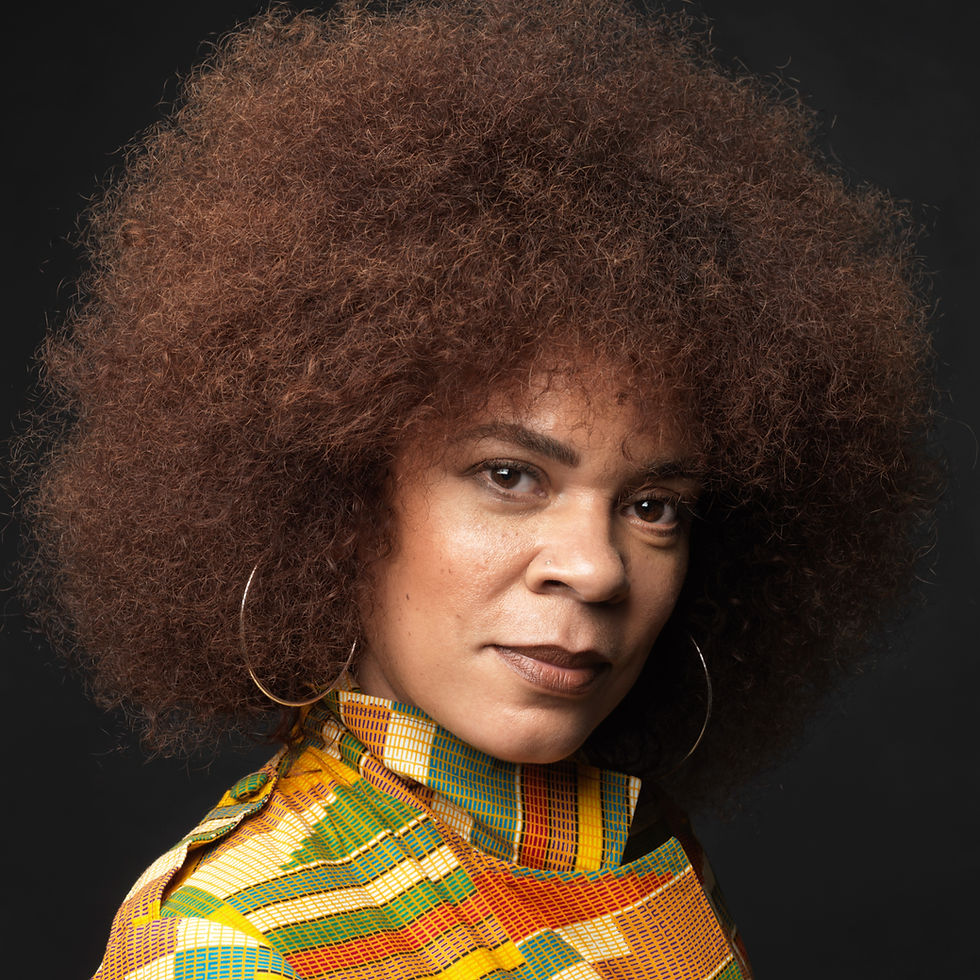
Nandi Comer is an award-winning poet and essayist. She was appointed as Michigan's poet laureate in 2023, becoming the state's first poet laureate since the 1950s.

Nandi Comer served as the 2nd Poet Laureate of the state of Michigan from 2023 to 2025. She is the author of the chapbook, American Family: A Syndrome (Finishing Line Press). Her debut poetry collection, Tapping Out (Triquarterly) won the Society of Midland Authors Award and Julie Suk Award. She has received fellowships from Cave Canem, Callaloo, Modern Ancient Brown, Mass Moca, the Academy of American Poets, among others. She currently serves as the 2025-2026 Jay C. and Ruth Halls Poetry Fellow at the Wisconsin Institute for Creative Writing and as a co-Director of Detroit Lit. Photo credit: Khary Mason
It Was Still the 90s
The decade I fell for so many boys
in Jodeci boots. I started
my period, finished grade school,
middle school, then high school
and it was still the 90s. When a girl
and her sisters followed me home
wanting a fight, I talked them down
with reason and my mother’s
5lb weight in my lap. At sixteen
I let a boy have my virginity.
At seventeen, I told another
he was my first. A man
wanted to come to my house
for an innocent visit until
I told him I’d lost it. On TV
I watched everything from home:
MARTIN, O.J., Rodney, Aaliyah
OJ again. All so shiny and sweaty–then
frightening. All anyone wanted was to be fresh
and clean. We thought the world would end.
Y2K was coming, and the computers,
and the banks and me,
lifting my hands through all the falling confetti.
On Malice
On November 5, 1992, Malice Green died from blunt force trauma to the head after being assaulted by seven Detroit police officers. Of the seven, Walter Budzyn, Larry Nevers, and Robert Lessnau were the only ones to stand trial.
Who can understand a crack vile
and lighter, the soft rub
of a car’s worn carpet, the weight
of a flashlight, how its steel
can form a blunt blow?
I once was a steelworker
then I became a memorial mural,
multicolored balloons, a stuffed animal, an altar.
That night, TLC’s Baby, Baby, Baby hummed
from my car. Me, in a head haze,
tilting two steps from the house.
They pulled me half out of my car and half into
my afterlife. What could I have done
with no willing witness, no accomplice,
no camera to record my removal, my drag.
By the time the medics cradled my head,
lifted my limbs, drove me away handcuffed,
I was already a martyr. Whoever says my night
was small, a momentary slip
has never had their brain explode into seizures,
has never had to count the fists
to seven, to fourteen, to me.
Malice Green’s Mother Mourns Her Son
after Anne Sexton
I am taking off my funeral shoes
again. A jade stone grows heavy
in my belly. I have said it one too many times.
A boy, run down. A woman lost
on the operating table. But now
my son, a gone ghost, an orifice
no sorry can fill. I don’t have the breath
to kick off cemetery dust, slide the art
of mourning to the floor. My dress
can’t tell the cypress how
to do its dying song.
I am exhausted with all of my dying.
Death is a rat scurrying over my chest
and no one knows how to kill it. Beautiful whim,
come with your thin veins.
Lay your head in my lap.
I am ready to mourn you.
Skin. Light. Shade.
Almond. Peach. honey-
colored. We called them
so many sweet names. Did it matter?
We knew when pretty walked in and
side-eyed herself in a mirror. Jasmine Guy
Tisha Campbell, Halle Berry. Light girls,
we called pretty. Light boys, we called
pretty, while we chocolate, coffee,
dusty black girls remade ourselves
pink, lavender, fuchsia-lipped
hip-cocked, spread-thighed, dead-
pan cute. We propped our bodies’
awkward teeter on our knees’
unsteady lean on bathroom sinks,
necks tilted into our vanities.
I pressed, greased, curled, tucked,
and pinned my kinks. It was me
or a version of me alone
with the toffee-skinned child,
poor in clothes but pretty in skin. Gray,
my mother called her. Every day
she arrived on our doorstep, mud-smeared,
day-old funk stale. Nothing a curling iron,
or hair spray, or gel couldn’t smooth
into pretty. Her hue, her eyes made me
shadow under such glow. Today I am no better
standing in the grocery line, huffing to work,
leaning over the green billiards table.
I know my dark coy will get me so far,
while another’s curls and hair hair hair
tumbling over shoulders at the bar or mall or
café, sipping and sun-kissed,
the pink of their cheeks
shrinks me. I
fade disappear and
we all succumb
drown falling
into that monstrous
glimmering skin.
THE INTERVIEW
This interview was conducted between Nandi Comer and Jae Nichelle on October 8, 2025.
Thank you for sharing these incredible poems. “It was still the 90s” begins as such a personal and specific portrait and zooms out, by the end of the poem, to situate your speaker in the larger societal context of the time. How did you develop the lens through which you approached writing this poem?
Lately, I have been nostalgic about my adolescent years during the 1990s. I was inspired by today’s fascination with the '90s. It has been fantastic seeing some of our styles reemerge in the public eye, but today’s interest seems to be forgetting some of the core details that I experienced. Like, why don’t people talk about the anxiety we felt during Y2K!
I turned ten in 1990 and turned twenty right before Y2K. I wanted this poem to express the immensity of events and changes that occur in a decade: how the body changes, and what the individual experiences reveals about a collective culture. I wanted to tap into the specificity in that shaky transition from girlhood to adolescence and eventual young adult—and the dangers. That poem allowed me to explore my personal memories and contemplate how the “I” could be a universal nostalgic “we.”
“On Malice” and “Malice Green’s Mother Mourns her Son” are written through the perspective of Malice and then his mother. Do you have a process for how you so carefully adopt different voices in your work, especially those of real people?
The persona poem or the dramatic monologue is something I often tap into for storytelling. I am inspired by writers like Patricia Smith, Ai, and Wisława Szymborska. Persona allows me to better explore a topic or experience. At times, it feels like “spirit work” where I open myself and invite the voice to say what needs to be said. For a long time, I have used personas to deeply explore acts that confuse me, particularly acts of violence. I often wonder what it takes to inflict or endure violent acts.
Malice Green's murder was a case that rippled through Detroit and extended across the nation. There were daily vigils and protests immediately following his murder, and a long trial followed. Because the incident occurred nine months after the LA riots, everyone was afraid that Detroit would erupt into uprisings as well. Despite being a significant historical moment for Detroit, the Detroit Public Library has only one book about his death—a memoir by one of the police officers. In these two poems, I wanted to document two Detroit voices so that they are not forgotten. At a time when many communities' stories are in danger of being erased, the persona poem is an approach that allows me to retell as closely as possible and offer an archive for narratives that are already being forgotten.
As Michigan’s 2nd Poet Laureate (2023–2025), you launched “Michigan Words,” a statewide campaign of billboards that feature quotes from Michigan poets. What moments from that project stay with you most vividly?
The moment that stays with me most is the pride the writers expressed when they talked about their families seeing the billboards for the first time. M. Bartley Siegel told me his mom was more excited about the billboard than a lot of his other poetry accomplishments. Jonah Mixon-Webster called it life-changing. While I was traveling the state, I passed some of those billboards, and at times I’d get out of my car to take pictures. It was amazing seeing big, larger-than-life pictures of my peers. We all got to relish the stunning verse of poets like Brittany Rogers—whose author photo, by the way, is every bit as captivating as her lyric.
You also helped create the PBS/WKAR video series Michigan in Verse. What drew you to the video format for this project? How was the experience?
Before my appointment, Michigan had not had a Poet Laureate in 60 years. I was fortunate to be approached with many ideas for projects by so many community members. When WKAR and the Library of Michigan asked if I wanted to produce a poetry series, how could I say no? I immediately wanted to feature as many poets as possible. Michigan is so rich with a diverse poetry community. I wanted to bring the whole poetry family on set.
Collaboration was at the heart of everything I did as Michigan’s Poet Laureate. All of the events, readings, and conferences I did were the result of collective work. The Michigan in Verse was the result of a strong collaborative team where each individual member contributed their expertise to the project. The producers at WKAR possessed all the technical knowledge regarding cameras and sets. They turned to me for the knowledge about Michigan poets that would represent the state and bring a unique texture to the series. It was a very harmonious leadership strategy where we each deferred to the person who best knew when it was their time to conduct the production. It was great fun celebrating poets from around the state. The series is still up on the station's website for the world to view. I love it!
When thinking of the many fellowships you’ve held (from Cave Canem and Callaloo to your current fellowship with the Wisconsin Institute for Creative Writing), what aspects of these fellowships have most transformed your writing practice?
Of all the writing opportunities I have received, Cave Canem, by far, carries the most impact. It was my first writing retreat and the first time participating in an international community of writers. I met so many kinds of black writers—writers from New York to Montana to Washington. I met writers I had read, who I never thought I would have the opportunity to sit in a room with. It was hard work, but also a lot of fellowship. I forged forever friendships. The space broadened my understanding of what my life could be as a writer in the world. I don’t think I would have attempted anything that came after if I had not had that opportunity. I think every writer deserves a space that gives them a sense of belonging, one that completely transforms their understanding of themselves.
What questions are you exploring in your work right now?
I am thinking a lot about the role archives play in our community. The act of deeming someone important to society and asking them to place their personal and professional records in an archive is a wild thing we humans do. I am meditating on questions like who gets an official archive in a library. What spaces outside of libraries can be sustainable sites for archives? What kind of technology will allow for the longevity of an archive? What is appropriate for an archive? Letters to a Mayor? YouTube videos of 90s dance shows? Can my aunt's recipe box be an archive? It all boils down to what we as communities want to remember.
You were raised in Detroit and represent the city heavily in your writing. What do you love about Detroit’s literary scene?
Detroit’s literary scene is lovely. We have all kinds of poets. We have a history of literary giants, such as Dudley Randall and Robert Hayden, but we also have a rich performance and slam poetry scene with a dynamic legacy. Without the influence of a large institution driving a particular aesthetic, Detroiters tend to be self-taught or mentored by other poets. This develops a drive and hunger that is unique to each poet. In many cities, one can tell their local influences. I don’t see that in the writers from my city. Aricka Froeman, Brittany Rogers, Tommye Blount, jessica Care moore, and Jamaal May all write incredibly differently from one another, yet we all come from the same city. I love that!
Where would you take a food critic who was visiting Detroit?
You’re trying to get me in trouble. I'm not sure about a food critic, but any friend of mine who visits me in Detroit is going to get Middle Eastern food. Since the Detroit area is home to the largest Arab community in the United States, Middle Eastern cuisine is important to our culture. We take our falafel and shawarma very seriously. People try to take me to try restaurants in other regions, and they just don’t have the same flavor. We have drive-thru restaurants that are top-tier.
How can people support you right now?
I am expanding my teaching offerings. I would love to come to your community to teach. I've been working on new workshops and generative classes. Invite me out.
Name another Black woman writer people should follow.
Just one?!?!?! I am here for all black woman writers, but right now, I would love to uplift Jassmine Parks and Maryhilda Obasiota Ibe two very different poets, but fabulous writers.
###
Torch Literary Arts is a 501(c)3 nonprofit established to publish and promote creative writing by Black women. We publish contemporary writing by experienced and emerging writers alike. Programs include the Wildfire Reading Series, writing workshops, and retreats. Click here to support Torch Literary Arts.